Traditional Ninja Gear vs Modern Martial Arts Equipment — What Is the Difference?
Historical Shinobi Equipment, Modern Ninjutsugi, Japanese Footwear, Traditional Weapons and Functional Martial Arts Training Gear
When comparing traditional ninja gear and modern martial arts equipment, one important question emerges:
How much of the equipment associated with Japanese ninja reflects historical practices, and how much belongs to contemporary martial arts training?
The distinction is essential for anyone interested in authentic Japanese Ninjutsu, Togakure Ryū Ninpō (戸隠流忍法), traditional Japanese clothing and modern martial arts equipment.
Historical shinobi operated within specific social, military and environmental circumstances. Their clothing, tools and equipment were selected according to practical needs.
Modern Ninjutsu practitioners, however, train in dōjō, outdoor environments and organized martial arts schools using equipment adapted to contemporary practice.
Understanding these differences helps practitioners avoid historical misconceptions, choose appropriate training gear and recognize the relationship between traditional Japanese culture and modern martial arts equipment.
This Bujindō guide compares historical shinobi equipment, modern Shinobi Shōzoku, Ninjutsugi, Tabi, Jikatabi, Tekko, Kyahan and martial arts training weapons.
Quick Answer: Traditional Ninja Gear vs Modern Martial Arts Equipment
Traditional ninja gear and modern martial arts equipment differ mainly in their historical context, intended function, construction and training environment.
Historical shinobi used practical clothing, disguises, tools and equipment adapted to their activities and surroundings. There was no universal ninja uniform worn by every shinobi.
Modern Ninjutsu practitioners generally use standardized training uniforms, traditional-style Shinobi Shōzoku, Tabi, Jikatabi and supervised practice weapons.
Modern equipment prioritizes repeated training, mobility, durability, comfort and safety.
The best equipment is not necessarily the oldest-looking item. It is the equipment most appropriate for the practitioner's training.
1. Historical Origins of Ninja Equipment
The historical development of Ninjutsu (忍術) is associated with methods of intelligence gathering, concealment, reconnaissance, infiltration and other specialized activities within premodern Japanese society.
Shinobi (忍び) operated under circumstances that could require adaptation to different environments, social situations and military conditions.
Consequently, historical ninja equipment should not be understood as a fixed collection of specialized objects used identically by every practitioner.
Equipment Was Selected According to Circumstances
Historical shinobi could rely on ordinary clothing, travel equipment, practical tools and specialized implements depending on their assignments.
The ability to blend into an environment could be more useful than wearing clothing that immediately identified its wearer as a shinobi.
Practical equipment might serve several purposes, including travel, carrying necessities, concealment and movement through difficult terrain.
Historical Sources and Their Limitations
Japanese historical writings, including the Bansenshūkai (万川集海) and Shōninki (正忍記), provide important information about shinobi-related knowledge and practices.
These texts are valuable historical sources, but their descriptions must be interpreted within their original contexts.
They should not be used to claim that every modern commercial ninja accessory existed in precisely the same form during Japan's medieval or Sengoku periods.
Historical Accuracy Matters
Traditional Japanese craftsmanship, historical shinobi equipment and modern Ninjutsu training clothing are related subjects, but they are not interchangeable.
An item can be suitable for traditional martial arts practice without being an exact historical reproduction.
2. Did Historical Ninja Really Wear Black?
One of the most familiar images of the ninja is a warrior dressed entirely in black, wearing a hood and carrying specialized weapons.
Although this appearance is strongly associated with modern ninja imagery, it should not be interpreted as a universal historical uniform.
The Influence of Japanese Theater
The conventional all-black ninja costume has an important connection with Japanese theatrical traditions, including the visual conventions associated with stage assistants known as kurogo (黒衣).
Black clothing became a recognizable visual shorthand for concealed figures in later representations.
This helped shape the ninja image popularized through theater, illustrations, cinema and modern entertainment.
Historical Shinobi and Disguise
For historical shinobi, wearing clothing appropriate to the surrounding environment could be essential.
The objective of disguise was not necessarily to appear intimidating or mysterious.
It could involve avoiding attention and adapting to ordinary social circumstances.
Therefore, the idea that historical ninja always wore a standardized black outfit is misleading.
Are Modern Black Ninja Uniforms Incorrect?
Not necessarily.
A modern black Ninjutsugi can be practical, durable and appropriate for contemporary Ninjutsu training.
Its usefulness should be evaluated according to its construction and suitability for practice, not by assuming that it reproduces a universal historical shinobi uniform.
3. Traditional Shinobi Equipment vs Modern Martial Arts Training Gear
The clearest difference between historical shinobi equipment and contemporary martial arts equipment is their intended context.
Historical Equipment: Adaptation to Practical Needs
Historically, clothing and equipment were selected according to travel requirements, environmental conditions, social circumstances and the tasks being performed.
There was no universal modern-style purchasing checklist that applied to all shinobi.
Modern Equipment: Repeated Martial Arts Practice
Modern martial arts equipment is generally designed for structured training.
Practitioners may attend regular lessons, perform repeated exercises, practice controlled techniques and train with partners.
Equipment must therefore support consistent movement and withstand repeated use.
Important considerations include:
- Comfort and correct sizing.
- Fabric flexibility.
- Durable seams and construction.
- Appropriate movement around the hips and shoulders.
- Suitable footwear for the training surface.
- Compatibility with supervised practice.
- Ease of maintenance and cleaning.
The Essential Difference
Historical shinobi equipment: Selected according to the circumstances and practical requirements of its original environment.
Modern Ninjutsu equipment: Selected according to the requirements of contemporary martial arts training, movement, durability and safety.
4. Shinobi Shōzoku vs Ninjutsugi: Traditional-Style Clothing and Modern Training Uniforms
Two important terms encountered when purchasing Ninjutsu clothing are Shinobi Shōzoku and Ninjutsugi.
Although these garments may share similar characteristics, their contemporary purposes are not always identical.
Shinobi Shōzoku (忍び装束)
Shinobi Shōzoku is commonly used to describe traditional-style ninja clothing.
Modern Shinobi Shōzoku sets may include:
- Uwagi (上着) — upper garment or jacket.
- Traditional-style trousers.
- Obi (帯) — Japanese belt.
- Zukin (頭巾) — hood.
- Tekko (手甲) — hand and forearm coverings.
- Kyahan (脚絆) — lower-leg wraps.
The composition depends on the manufacturer and the specific model.
Some traditional-style sets are designed for martial arts practice. Others prioritize historical appearance, costume use or cultural presentation.
These differences must be assessed individually.
Explore Shinobi ShōzokuNinjutsugi (忍術着)
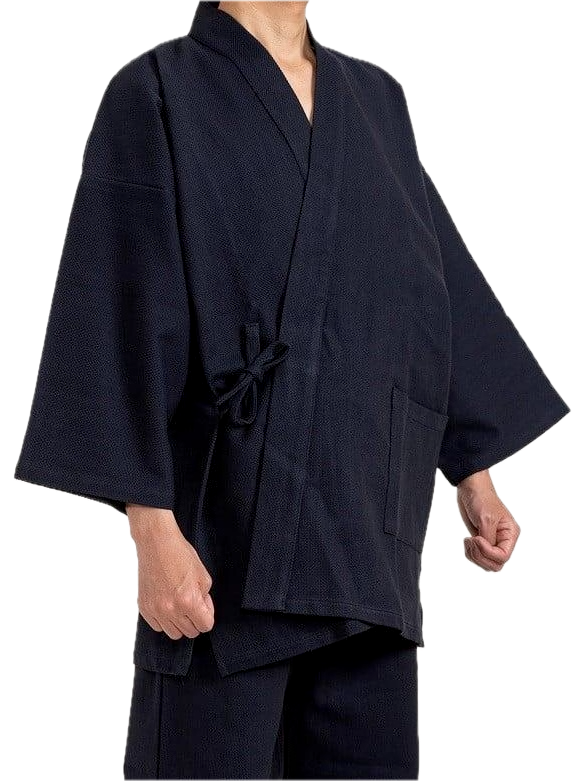
A Ninjutsugi is a uniform associated with modern Ninjutsu training.
Its construction may resemble other Japanese martial arts uniforms, with variations in fabric, cut and weight.
For repeated Taijutsu practice, the uniform should allow:
- Natural movement of the shoulders.
- Comfortable bending of the knees.
- Freedom of movement through the hips.
- Controlled rolling and falling.
- Stable movement between different postures.
- Comfort during prolonged training sessions.
The most important consideration is functional suitability.
A well-constructed Ninjutsugi should not interfere with natural body movement.
Shop Ninjutsugi UniformsShinobi Shōzoku vs Ninjutsugi — Comparison
| Feature | Shinobi Shōzoku | Ninjutsugi |
|---|---|---|
| Primary Association | Traditional-style ninja clothing | Contemporary Ninjutsu training |
| Typical Components | Jacket, trousers and optional accessories | Training jacket and trousers |
| Appearance | Traditional-style shinobi design | Modern martial arts uniform |
| Training Suitability | Depends on construction | Generally intended for regular training |
| Historical Accuracy | Not automatically a historical reproduction | Modern training garment |
| Beginner Priority | Usually optional | Often practical when required by the dōjō |
Bujindō Recommendation
Choose a Ninjutsugi for regular training when it meets your instructor's requirements.
Choose a traditional-style Shinobi Shōzoku when its construction, components and intended use are appropriate for your practice.
5. Traditional Japanese Footwear vs Modern Jikatabi
Japanese footwear is an important subject when comparing historical clothing with contemporary Ninjutsu equipment.
However, several different types of traditional and modern footwear are frequently confused.
Tabi (足袋) — Traditional Japanese Split-Toe Foot Coverings
Tabi are traditional Japanese split-toe foot coverings.
They separate the big toe from the remaining toes and are historically associated with Japanese clothing and footwear.
Fabric Tabi can be suitable for certain indoor activities, including martial arts practice when permitted by the instructor.
However, traditional textile Tabi generally provide limited protection from outdoor surfaces.
Waraji (草鞋) — Traditional Japanese Straw Sandals
Waraji are traditional Japanese sandals historically made from braided straw or other plant fibers.
They were used by travelers, workers and others engaged in practical outdoor activities.
Their historical relevance does not mean they provide the same protection as modern outdoor footwear.
Jikatabi (地下足袋) — Modern Japanese Outdoor Footwear
Modern Jikatabi are Japanese split-toe footwear equipped with external rubber soles.
The familiar rubber-soled Jikatabi developed in modern Japan, particularly during the early twentieth century.
They should not be described as unchanged medieval ninja footwear.
Contemporary Jikatabi may be useful for:
- Outdoor martial arts practice.
- Movement on suitable natural surfaces.
- Activities requiring flexible footwear.
- Situations where close ground contact is desirable.
However, different soles provide different levels of grip, cushioning and protection.
Wet stone, loose gravel, mud and steep terrain present different challenges.
No footwear can guarantee silent movement or eliminate slipping hazards.
Explore Japanese JikatabiWhy Footwear Matters in Ninjutsu
The feet play an essential role in balance, posture, stepping and changes of direction.
In Ninpō Taijutsu, correct movement depends on coordination between the entire body and the surrounding environment.
Footwear can influence traction and contact with the ground, but technical ability must be developed through practice.
For a more detailed explanation, read our Tabi vs Jikatabi Guide — What Is the Difference? .
6. Tekko and Kyahan: Traditional Japanese Accessories vs Modern Training Equipment
Tekko and Kyahan are traditional Japanese clothing accessories that continue to appear in contemporary Ninjutsu outfits.
Their construction and functions should be understood in relation to Japanese clothing history and modern training requirements.
Tekko (手甲) — Hand and Forearm Coverings
Tekko are Japanese coverings worn around the hands, wrists or forearms, depending on their design.
Traditional forms have been associated with Japanese clothing used for travel, work and other activities.
In modern Ninjutsu clothing, Tekko may be incorporated into a traditional-style outfit.
Depending on their construction, they may help cover the forearms or secure loose garment fabric.
However, textile Tekko should not be confused with modern impact-tested protective equipment.
Explore Japanese TekkoKyahan (脚絆) — Traditional Lower-Leg Wraps
Kyahan are Japanese leg wraps or gaiters worn around the lower legs.
Their practical functions may include keeping loose trouser fabric close to the legs and providing limited coverage during travel or physical activity.
Modern Kyahan may use different fastening systems, including traditional-style hooks or adjustable textile closures.
Their suitability depends on material, fit and intended use.
Discover Japanese KyahanTraditional Coverage vs Modern Impact Protection
It is important to distinguish traditional clothing accessories from specialized modern protective gear.
Traditional textile Tekko and Kyahan may offer clothing coverage, but they do not automatically provide substantial protection against strikes or other injuries.
Modern protective equipment may incorporate padding or other specialized materials.
The protection provided must be evaluated according to the individual product and its intended use.
7. Historical Ninja Weapons vs Modern Martial Arts Practice Weapons
The study of Japanese Ninjutsu includes traditions involving different weapons, tools and practical implements.
However, the equipment used in historical circumstances must be distinguished from the tools used during contemporary supervised training.
Historical Martial Arts Weapons
Historical Japanese martial traditions included a wide variety of weapons and practical implements.
Examples associated with particular Japanese martial traditions include:
- Bō (棒) — long staff.
- Hanbō (半棒) — shorter staff.
- Jō (杖) — medium-length staff.
- Kenjutsu-related swords and sword techniques.
- Shuriken (手裏剣) — throwing implements.
- Kusarigama (鎖鎌) — chain-and-sickle weapon.
- Nawa (縄) — rope used in different practical and martial contexts.
These examples should not be interpreted as evidence that every weapon belonged to every historical Ninjutsu school.
Specific historical associations require appropriate documentary or transmission-based evidence.
Modern Practice Weapons
Contemporary martial arts training uses practice tools selected according to the curriculum, training objectives and level of supervision.
Examples may include wooden staffs, wooden swords and other instructor-approved practice implements.
Modern practice equipment may differ from historical weapons in materials, dimensions, construction and purpose.
Safety Comes Before Historical Appearance
A training tool should not be selected solely because it resembles a historical weapon.
Its suitability depends on the exercise, the experience of the practitioner, the environment and the instructor's requirements.
Beginners should not purchase dangerous weapons without appropriate instruction.
Important Training Principle
Historical appearance does not guarantee training safety. Even wooden practice weapons can cause serious injuries when used incorrectly.
8. Traditional Equipment and Modern Practice in Togakure Ryū Ninpō Taijutsu
Togakure Ryū Ninpō (戸隠流忍法) is a Japanese martial tradition transmitted in modern times through the teachings of Hatsumi Masaaki (初見良昭), Sōke and founder of the Bujinkan organization.
Its contemporary practice includes the study of Ninpō Taijutsu, body movement, martial techniques and traditional knowledge.
Within this training approach, equipment should support the natural movement and technical development of the practitioner.
Kamae (構え) — Posture and Readiness
Training clothing must allow the practitioner to adopt and change postures without unnecessary restriction.
A uniform that limits the hips, knees or shoulders can interfere with movement.
Maai (間合い) — Distance and Spatial Awareness
The understanding of Maai requires awareness of distance, timing and the relationship between individuals.
Equipment should not interfere with stepping, positioning or natural changes of direction.
Tai Sabaki (体捌き) — Natural Body Movement
Tai Sabaki requires coordinated movement of the whole body.
Appropriate clothing should support turning, lowering the body and adjusting posture without unnecessary resistance.
Ukemi (受身) — Receiving and Managing Falls
Ukemi training includes methods of receiving falls, rolling and maintaining body awareness.
The uniform must allow these movements without loose accessories creating avoidable hazards.
Shinobi Aruki (忍び歩き) — Controlled Stealth Walking
Shinobi Aruki involves the study of controlled walking, balance and awareness of the surrounding environment.
Although footwear influences contact with the ground, stealth-related movement cannot be developed through equipment alone.
It requires observation, physical coordination and repeated practice.
The Bujindō Perspective on Authentic Practice
Traditional knowledge and modern equipment should not be considered opposing concepts.
The essential question is whether the equipment supports the technical demands of genuine martial arts practice.
A historically inspired garment may be appropriate when its construction allows unrestricted movement.
Likewise, a modern uniform may be entirely suitable for studying traditional Ninpō Taijutsu.
The quality of martial practice depends on instruction, understanding, patience and perseverance — not on appearance alone.
To discover Togakure Ryū Ninpō training in Kyoto, Japan, visit Ninjutsu Kyoto — Togakure Ryū Ninpō Dōjō .
9. Traditional Ninja Gear vs Modern Martial Arts Equipment: Complete Comparison Table
The following table summarizes the most important differences between historical Japanese equipment, modern traditional-style ninja clothing and contemporary martial arts training gear.
| Equipment | Historical or Traditional Context | Modern Martial Arts Use |
|---|---|---|
| Shinobi Clothing | Clothing adapted to circumstances and practical activities | Traditional-style Shinobi Shōzoku outfits |
| Ninjutsugi | No universal historical equivalent as a standardized modern uniform | Regular Ninjutsu training |
| Tabi | Traditional Japanese split-toe foot coverings | Traditional wear and suitable indoor practice |
| Jikatabi | Modern Japanese outdoor footwear with rubber soles | Outdoor work and suitable martial arts training |
| Waraji | Traditional Japanese straw sandals | Cultural study and specialized traditional-style use |
| Tekko | Japanese hand and forearm coverings | Traditional-style clothing accessories |
| Kyahan | Japanese lower-leg wraps or gaiters | Garment fastening and traditional-style training clothing |
| Traditional Weapons | Weapons and tools associated with particular historical traditions | Technical study using appropriate training methods |
| Modern Practice Weapons | Contemporary adaptations of traditional weapon forms | Supervised martial arts exercises |
Historical uses varied considerably according to period, region and social context. The table is a general comparison, not a definitive inventory of equipment used by all historical shinobi.
10. Which Equipment Should You Choose for Ninjutsu Training?
Choosing between traditional-style and modern martial arts equipment depends on your objectives.
For Beginners
Choose comfortable clothing approved by your instructor.
A dedicated Ninjutsugi may be useful once regular training begins.
Avoid purchasing unnecessary accessories before understanding the requirements of your dōjō.
For Regular Indoor Training
Prioritize:
- A comfortable training uniform.
- Appropriate belt when required.
- Footwear permitted by the instructor.
- Durable construction.
- Freedom of movement.
For Outdoor Ninjutsu Training
Consider:
- Footwear suited to the terrain.
- Weather-appropriate clothing.
- Durable garments.
- Secure fastening systems.
- Suitable protection against environmental hazards.
Appropriate Jikatabi may be useful for certain outdoor training activities.
However, sole construction and terrain conditions must be evaluated carefully.
For Traditional-Style Training
A Shinobi Shōzoku may be suitable when its construction meets the requirements of the activity.
Tekko and Kyahan may also be relevant depending on the outfit and training objectives.
For Advanced Martial Arts Study
Equipment requirements may become more specialized as the curriculum develops.
Purchase additional training tools only when recommended by your instructor.
11. What Makes Ninjutsu Equipment Authentic?
The word authentic is frequently used when describing Japanese martial arts equipment.
However, authenticity can refer to several different characteristics.
Historical Authenticity
Historical authenticity concerns whether an object accurately reflects a particular historical period, construction method or documented form.
A product should not be described as a historical replica without appropriate supporting evidence.
Traditional Japanese Craftsmanship
An item may be produced using Japanese textile traditions, manufacturing methods or traditional garment forms.
This craftsmanship can have cultural value without making the product an exact reproduction of medieval shinobi equipment.
Functional Authenticity
For martial arts practitioners, functional suitability is especially important.
Equipment should support the movements, conditions and demands of training.
A functional modern uniform may be more appropriate for regular practice than an elaborate garment designed mainly for display.
Traditional Knowledge and Correct Practice
The most important distinction is between owning equipment and understanding how to use it appropriately.
Traditional martial arts knowledge cannot be acquired simply by purchasing specialized clothing.
Correct instruction, technical development and consistent practice remain fundamental.
12. Common Misconceptions About Traditional Ninja Equipment
Misconception 1: All Historical Ninja Wore Black Uniforms
Historical shinobi did not necessarily wear a standardized black outfit.
Clothing could vary according to practical needs and social circumstances.
Misconception 2: Modern Jikatabi Are Medieval Ninja Footwear
Modern rubber-soled Jikatabi developed long after Japan's medieval period.
They should not be confused with earlier forms of Japanese footwear.
Misconception 3: Traditional-Looking Equipment Is Always Better
Historical appearance does not guarantee durability, comfort or suitability for martial arts practice.
Misconception 4: Every Ninja Used the Same Weapons
Different Japanese martial traditions preserved different weapons and technical methods.
Historical associations must be evaluated individually.
Misconception 5: Traditional Accessories Provide Modern Protective Performance
Textile Tekko and Kyahan should not automatically be considered equivalent to specialized impact-protection equipment.
Misconception 6: Expensive Ninja Equipment Produces Better Martial Skills
Equipment may support training, but it cannot replace qualified instruction, physical practice or technical understanding.
13. Frequently Asked Questions About Traditional Ninja Gear and Modern Martial Arts Equipment
What is the difference between traditional ninja gear and modern martial arts equipment?
Traditional ninja gear refers to equipment associated with historical shinobi practices, while modern martial arts equipment is generally designed for contemporary supervised training.
The main differences involve historical context, construction, purpose and safety requirements.
Did historical ninja wear black uniforms?
There was no universal black uniform worn by every historical shinobi. The familiar black ninja outfit is strongly associated with later theatrical and popular representations.
What is the difference between Shinobi Shōzoku and Ninjutsugi?
Shinobi Shōzoku generally refers to traditional-style ninja clothing, while Ninjutsugi refers to contemporary Ninjutsu training uniforms.
Their designs may overlap, and suitability depends on construction and intended use.
Is traditional ninja clothing suitable for modern Ninjutsu training?
Traditional-style ninja clothing can be suitable for training when it allows unrestricted movement and meets the instructor's requirements.
However, not every outfit is constructed for demanding martial arts practice.
Were Jikatabi worn by medieval ninja?
Modern rubber-soled Jikatabi developed in twentieth-century Japan. They should not be presented as unchanged medieval ninja footwear.
What footwear is best for Ninjutsu?
The best footwear depends on the training surface and the instructor's requirements.
Traditional fabric Tabi may be suitable for certain indoor uses, while appropriate Jikatabi may be useful outdoors.
Are Tekko and Kyahan traditional ninja equipment?
Tekko and Kyahan are traditional Japanese clothing accessories.
They are incorporated into many contemporary traditional-style ninja outfits, but their presence does not prove that every historical shinobi used identical equipment.
Are historical ninja weapons suitable for beginners?
Beginners should use only appropriate practice tools approved by their instructor.
Historical weapons and modern training implements have different purposes and safety considerations.
Does authentic Ninjutsu require traditional ninja clothing?
No particular garment can establish the authenticity of a martial tradition.
Technical knowledge, qualified instruction, training methods and historical understanding are more important.
Where can I buy traditional Japanese Ninjutsu equipment?
Bujindō offers selected Japanese martial arts clothing, footwear and traditional-style Ninjutsu accessories.
Available collections include Shinobi Shōzoku, Ninjutsugi, Jikatabi, Tekko and Kyahan.
14. Shop Traditional and Modern Ninjutsu Equipment at Bujindō
Bujindō (武神堂) is based in Kyoto, Japan, and specializes in selected Japanese martial arts clothing, Ninjutsu equipment and traditional Japanese culture.
Our approach reflects practical experience in traditional Japanese martial arts, including Togakure Ryū Ninpō.
Rather than evaluating equipment only by its appearance, we emphasize:
- Practical training suitability.
- Freedom of movement.
- Appropriate materials and construction.
- Comfort and correct sizing.
- Traditional Japanese craftsmanship.
- Responsible martial arts practice.
Explore Our Ninjutsu Collections
Shinobi Shōzoku — Traditional-Style Ninja Clothing
Explore Japanese ninja outfits and coordinated traditional-style training clothing.
Shop Shinobi ShōzokuNinjutsugi — Modern Ninjutsu Training Uniforms
Compare practical Japanese martial arts uniforms for regular Taijutsu training.
Shop NinjutsugiJikatabi — Japanese Outdoor Split-Toe Footwear
Discover Japanese footwear for suitable outdoor activities and martial arts practice.
Shop Japanese JikatabiTekko — Japanese Hand and Forearm Coverings
Explore traditional Japanese Tekko in different materials and fastening styles.
Shop Japanese TekkoKyahan — Traditional Japanese Leg Wraps
Discover Japanese Kyahan for traditional-style clothing and suitable training use.
Shop Japanese KyahanContinue Learning About Ninjutsu Equipment
Understanding the relationship between historical Japanese equipment and contemporary martial arts practice is an important part of choosing appropriate gear.
Explore our complementary guides:
- What Is Ninjutsu Equipment? — Complete Guide to Traditional Ninja Gear
- Essential Ninjutsu Gear for Beginners — What Do You Need to Start Training?
- Ninjutsu Equipment Guide — Traditional Ninja Gear for Training
- Tabi vs Jikatabi — What Is the Difference?
- Bujindō Buyer Guide — Japanese Martial Arts Equipment
About the Author — Jérôme Pailliette
Jérôme Pailliette is a French Ninjutsu instructor based in Kyoto, Japan, specializing in the study and teaching of Togakure Ryū Ninpō.
His martial arts journey includes decades of practice and study of Japanese martial traditions.
The Bujindō educational approach draws upon practical training, Japanese martial culture and the importance of understanding the function of equipment.
The purpose of these guides is to help practitioners distinguish historical knowledge, modern training requirements and commercial representations of ninja equipment.
Discover more about our philosophy on the Bujindō — Our Story page.
Conclusion: Traditional Knowledge and Modern Equipment Should Work Together
Traditional ninja equipment and contemporary martial arts gear should not be viewed as entirely opposing concepts.
Historical shinobi used clothing and tools adapted to their circumstances.
Modern practitioners use equipment selected for contemporary martial arts training.
The essential distinction is not simply between old and new.
It is between equipment that serves a genuine practical purpose and equipment selected primarily for appearance.
From Shinobi Shōzoku and Ninjutsugi to Tabi, Jikatabi, Tekko and Kyahan, each item should be evaluated according to its construction, purpose and suitability for practice.
Traditional knowledge provides historical and cultural understanding.
Modern equipment can support the needs of regular training.
Neither can replace correct martial arts instruction and consistent practice.
Authenticity is not merely what you wear. It is also what you understand and how you practice.
Bujindō 武神堂 — Traditional Japanese Martial Arts Equipment, Knowledge and Practice.