What Is Ninjutsu Equipment? — Complete Guide to Traditional Ninja Gear
Understanding Traditional Japanese Ninja Clothing, Footwear, Protective Accessories, Training Weapons and Martial Arts Equipment
Ninjutsu equipment represents much more than the black clothing commonly associated with ninja in movies and popular culture.
Throughout Japanese history, shinobi relied on practical clothing, tools and equipment adapted to their activities, surroundings and objectives.
Today, traditional Japanese Ninjutsu equipment continues to influence the clothing and accessories used by practitioners of Ninjutsu, Ninpō Taijutsu and other classical Japanese martial arts.
From Shinobi Shōzoku (忍び装束) and Ninjutsugi (忍術着) to Tabi (足袋), Jikatabi (地下足袋), Tekko (手甲) and Kyahan (脚絆), each item has particular characteristics and practical uses.
This comprehensive Bujindō guide explains what Ninjutsu equipment is, how different items are used, how historical equipment differs from modern training gear, and how to select appropriate equipment for serious martial arts practice.
Quick Answer: What Is Ninjutsu Equipment?
Ninjutsu equipment refers to the clothing, footwear, accessories, training tools and weapons associated with traditional Japanese shinobi practices and contemporary Ninjutsu training.
Modern equipment commonly includes Ninjutsugi training uniforms, Shinobi Shōzoku, Japanese Tabi, rubber-soled Jikatabi, Tekko hand coverings, Kyahan leg wraps, belts and instructor-approved practice weapons.
The purpose of suitable Ninjutsu equipment is to support natural movement, mobility, comfort, protection, environmental adaptation and effective martial arts training.
However, no single standardized equipment set represents every historical shinobi tradition or modern Ninjutsu school.
1. What Is Ninjutsu Equipment?
Ninjutsu (忍術) is a Japanese martial and strategic tradition associated with the historical activities of shinobi, including intelligence gathering, concealment, infiltration, reconnaissance, survival and other specialized skills.
Its historical practices developed within the social, military and geographical conditions of Japan, particularly during periods of political and military conflict.
Unlike modern competitive martial arts, traditional Ninjutsu was not developed primarily around sporting competition, scoring systems or regulated matches.
Consequently, the selection and use of equipment must be understood in relation to practical function, environmental conditions and the requirements of different activities.
In contemporary martial arts practice, Ninjutsu equipment generally falls into five main categories:
- Clothing: Shinobi Shōzoku, Ninjutsugi, jackets, trousers and belts.
- Footwear: Tabi, Jikatabi and traditional Japanese sandals.
- Accessories: Tekko, Kyahan and other clothing attachments.
- Training tools: Equipment used for physical conditioning and technical practice.
- Weapons: Instructor-approved training versions of traditional Japanese martial arts weapons.
The correct equipment depends on the specific martial tradition, the training environment, the practitioner's experience and the objectives of the practice.
2. Historical Origins of Ninja Equipment
Shinobi Equipment in Historical Japan
The history of Japanese shinobi is closely associated with the practical demands of warfare, information gathering, travel and movement through different environments.
Historical accounts of shinobi activities and later Ninjutsu writings describe methods involving concealment, disguise, practical tools and adaptation to circumstances.
However, it is important to distinguish between historically documented equipment, later martial traditions and modern representations of the ninja.
Did Historical Ninja Always Wear Black?
No. The familiar image of a ninja dressed entirely in black does not represent a universal historical uniform.
The conventional black ninja costume became strongly associated with theatrical representations and later popular culture.
For actual concealment or intelligence gathering, ordinary clothing and disguises appropriate to the surrounding environment could be more practical than a distinctive martial arts uniform.
This distinction is essential when studying traditional Japanese Ninjutsu equipment.
Modern Shinobi Shōzoku uniforms may preserve elements of traditional Japanese clothing, but their contemporary designs should not automatically be presented as exact reproductions of garments worn by every historical shinobi.
3. The Essential Principles of Ninjutsu Equipment
Traditional Ninjutsu equipment should be evaluated according to its practical characteristics rather than appearance alone.
Natural Movement
Clothing must allow the practitioner to move naturally without restricting the shoulders, hips, knees or ankles.
This is particularly important when practicing Tai Sabaki (体捌き), Ukemi (受身), Kamae (構え), changes of direction and movements close to the ground.
Adaptability
Training in an indoor dōjō is different from training in a forest, on grass, on gravel or on mountain paths.
Equipment should therefore be selected according to the surrounding terrain and environmental conditions.
Comfort and Durability
Repeated martial arts practice requires clothing that can tolerate regular movement, friction, washing and changes in posture.
The quality of the fabric, seams, fastening systems and fit can be more important than decorative details.
Protection and Safety
Suitable footwear and clothing can provide limited protection against environmental contact and abrasion.
However, traditional clothing accessories must not be confused with certified protective equipment designed to absorb martial arts impacts.
Environmental Awareness
The choice of equipment can influence how the practitioner interacts with the ground, surrounding obstacles and the training environment.
Nevertheless, silent movement, balance and effective body control must be developed through training. They cannot be obtained simply by wearing specialized shoes.
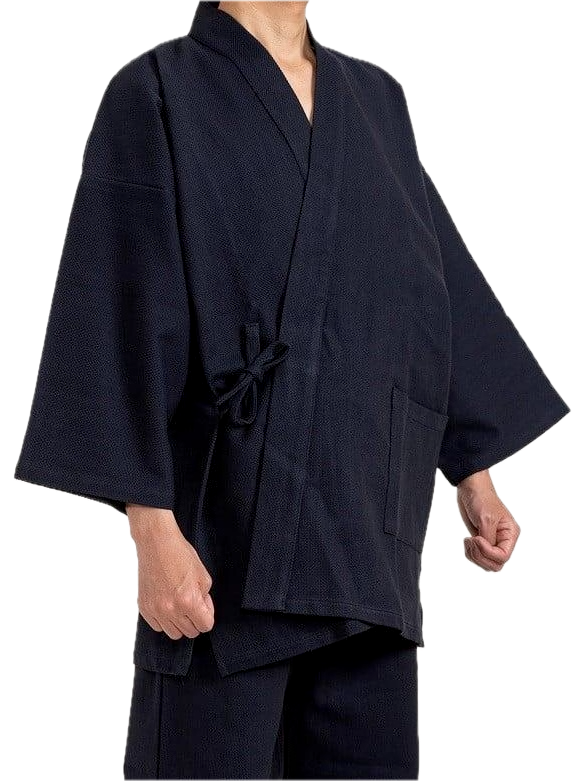
4. Traditional Ninja Clothing: Shinobi Shōzoku and Ninjutsugi
Shinobi Shōzoku (忍び装束) — Traditional-Style Ninja Clothing
Shinobi Shōzoku is the Japanese term commonly used today for traditional-style ninja clothing.
Contemporary Shinobi Shōzoku sets may include several coordinated garments:
- Uwagi (上着) — upper garment or jacket.
- Trousers designed for freedom of movement.
- Obi (帯) — belt.
- Zukin (頭巾) — hood or head covering.
- Tekko (手甲) — hand and forearm coverings.
- Kyahan (脚絆) — lower-leg wraps.
The exact composition varies according to the design, manufacturer and intended use.
For regular practice, a Shinobi Shōzoku should allow comfortable movement, bending, kneeling, rolling and transitions between different postures.
At Bujindō, traditional-style Shinobi Shōzoku clothing is selected with attention to Japanese craftsmanship, construction and practical suitability for training.
Explore Traditional Shinobi Shōzoku Outfits
Ninjutsugi (忍術着) — Modern Ninjutsu Training Uniform
A Ninjutsugi is a martial arts uniform used for contemporary Ninjutsu training.
Its design may be similar to other Japanese martial arts uniforms, with adjustments appropriate to the practitioner's movements.
A suitable Ninjutsugi should provide:
- Freedom of movement through the hips and shoulders.
- Comfortable bending and kneeling.
- Durable fabric and stitching.
- Appropriate sleeve and trouser length.
- A secure fit without unnecessary restriction.
The correct choice depends on the intensity of training, the dōjō's requirements and the practitioner's preferences.
5. Ninja Footwear: Tabi, Jikatabi and Waraji
Footwear is an important consideration in Ninjutsu because the feet establish contact with the ground and contribute to posture, balance and movement.
Tabi (足袋) — Traditional Japanese Split-Toe Footwear
Tabi are traditional Japanese foot coverings characterized by the separation of the big toe from the remaining toes.
They are traditionally associated with Japanese clothing and footwear such as Zōri and Geta.
Certain textile Tabi are also used by contemporary martial arts practitioners.
For suitable indoor Ninjutsu practice, lightweight Tabi may allow close contact with the training floor and relatively unrestricted foot movement.
However, traditional fabric Tabi generally provide limited protection and should not be treated as outdoor protective footwear.
Read Our Complete Ninja Tabi Guide
Jikatabi (地下足袋) — Japanese Outdoor Split-Toe Footwear
Jikatabi are Japanese split-toe footwear equipped with an external sole, usually made from rubber.
Unlike traditional textile Tabi, Jikatabi were developed as practical footwear for outdoor activities.
Modern Jikatabi are associated with Japanese workwear, festivals and certain forms of outdoor martial arts training.
For Ninjutsu practitioners training in natural environments, appropriately selected Jikatabi may provide:
- Flexible foot movement.
- Direct awareness of the ground.
- Traction suited to particular surfaces.
- Greater sole protection than textile Tabi.
- Practical mobility in appropriate outdoor conditions.
The rubber sole does not guarantee grip on wet rocks, slippery surfaces or unstable ground.
Footwear must always be selected according to terrain, weather and the required level of protection.
Explore Japanese Jikatabi for Outdoor Ninjutsu
Waraji (草鞋) — Traditional Japanese Straw Sandals
Waraji are traditional Japanese sandals historically made from braided straw or other plant fibers.
They were used by travelers, workers and other people moving through different environments in historical Japan.
Today, Waraji are primarily of interest for traditional Japanese clothing, cultural study and certain specialized training contexts.
Their construction, durability and level of protection differ substantially from modern outdoor footwear.
For indoor Ninjutsu practice, follow your instructor's rules concerning bare feet or suitable Tabi. For outdoor practice, select footwear according to the terrain and required protection. Textile Tabi and rubber-soled Jikatabi are not interchangeable.
6. Tekko and Kyahan — Traditional Japanese Protective Accessories
Tekko (手甲) — Japanese Hand and Forearm Coverings
Tekko are traditional Japanese coverings worn around the hands, wrists or forearms, depending on their construction.
They have been associated with different forms of Japanese clothing, including practical garments used for work, travel and other activities.
In contemporary Ninjutsu clothing, Tekko may help cover the forearms, secure garment sleeves or complete a coordinated training outfit.
Traditional textile Tekko should not be assumed to protect against punches, blades or heavy impacts.
Explore Traditional Japanese Tekko
Kyahan (脚絆) — Japanese Leg Wraps
Kyahan are traditional Japanese gaiters or leg wraps worn around the lower legs.
Historically, different forms of leg coverings were used to secure clothing and reduce interference from loose fabric during travel and physical activity.
Today, Kyahan are also used as components of traditional-style Shinobi Shōzoku outfits.
Depending on their construction, they may help keep trouser fabric close to the legs and provide limited coverage against environmental contact.
Their practical effectiveness depends on the material, fit and fastening system.
7. Traditional Ninja Weapons and Training Tools
Japanese Ninjutsu traditions include the study of different martial techniques, weapons and practical tools.
The precise weapons and training methods vary according to the historical school, lineage and contemporary curriculum.
Examples of equipment associated with Japanese martial traditions include:
- Bō (棒): long wooden staff.
- Hanbō (半棒): shorter staff.
- Jō (杖): medium-length staff.
- Bokken or Bokutō (木剣・木刀): wooden training sword.
- Shuriken (手裏剣): throwing implements studied in particular traditions.
- Kusarigama (鎖鎌): chain-and-sickle weapon associated with specific Japanese martial traditions.
- Nawa (縄): rope used in different traditional practical and martial contexts.
Not every item in this list belongs to every historical Ninjutsu school.
The relationship between a weapon and a particular tradition must be supported by appropriate historical or transmission-based evidence.
Modern Ninjutsu Weapon Training
Modern martial arts practice requires particular attention to supervision, equipment condition and appropriate training methods.
Beginners should use only practice tools approved by their instructor and suitable for their experience.
Weapons should never be selected solely for their appearance or association with popular ninja imagery.
8. Ninjutsu Equipment in Togakure Ryū Ninpō
Togakure Ryū Ninpō (戸隠流忍法) is a Japanese martial tradition transmitted in modern times through the teachings of Hatsumi Masaaki (初見良昭), Sōke and founder of the Bujinkan organization.
Contemporary Togakure Ryū Ninpō practice emphasizes the relationship between martial techniques, natural body movement, timing, distance and awareness of the surrounding environment.
Within Ninpō Taijutsu, clothing and equipment must support the movements required by training.
Kamae (構え) — Posture and Readiness
A suitable uniform should allow the practitioner to adopt and change postures without unnecessary restriction.
Maai (間合い) — Distance and Spatial Relationship
Effective control of distance depends on observation, timing, positioning and movement.
Equipment should not interfere with natural stepping, changes of direction or balance.
Tai Sabaki (体捌き) — Natural Body Movement
Tai Sabaki involves coordinated movement of the body in response to changing circumstances.
Clothing that restricts the hips, shoulders or legs can interfere with technical development.
Ukemi (受身) — Receiving and Managing Falls
Rolling, falling and changing levels require freedom of movement and an appropriate training surface.
Training clothing must allow these movements without catching, pulling or creating unnecessary obstacles.
Shinobi Aruki (忍び歩き) — Stealth Walking
Traditional Ninjutsu training includes the study of controlled movement and awareness of one's surroundings.
Footwear can influence contact with the ground, but effective movement depends primarily on body control, balance, observation and practice.
The Bujindō Training Philosophy
The study of traditional Ninjutsu equipment should never be separated from the practice of Ninpō Taijutsu.
A uniform does not create a martial artist. A specialized weapon does not replace understanding. And equipment alone cannot develop natural movement.
Practice, patience, perseverance and correct instruction remain the foundations of genuine martial development.
For information about traditional Togakure Ryū Ninpō training in Kyoto, Japan, visit Ninjutsu Kyoto — Togakure Ryū Ninpō Dōjō .
9. Ninjutsu Equipment Comparison Table
The following table summarizes the main categories of traditional-style and contemporary Ninjutsu equipment.
| Equipment | Japanese | Primary Function | Typical Modern Use |
|---|---|---|---|
| Shinobi Shōzoku | 忍び装束 | Traditional-style clothing | Ninjutsu clothing and practice |
| Ninjutsugi | 忍術着 | Training uniform | Regular dōjō practice |
| Tabi | 足袋 | Split-toe foot covering | Traditional wear and suitable indoor practice |
| Jikatabi | 地下足袋 | Outdoor split-toe footwear | Outdoor work and martial training |
| Waraji | 草鞋 | Traditional sandals | Traditional clothing and cultural study |
| Tekko | 手甲 | Hand and forearm covering | Traditional-style clothing |
| Kyahan | 脚絆 | Lower-leg wrap | Garment fastening and traditional-style clothing |
| Bokken | 木剣 | Wooden training sword | Supervised martial arts practice |
10. How to Choose the Right Ninjutsu Equipment
Choosing the right equipment requires more than selecting the most traditional-looking outfit.
Before purchasing Ninjutsu equipment, consider the following factors.
Training Environment
Indoor practice, outdoor training and mountain environments have different requirements.
The correct footwear and clothing must be compatible with the intended training surface.
Correct Sizing
A training uniform should allow comfortable movement without excessive fabric interfering with practice.
Footwear must fit securely without compressing the toes.
Material and Construction
Compare the fabric, flexibility, thickness, fastening systems and overall construction.
Cotton and synthetic materials offer different characteristics depending on the garment.
Training Frequency
Regular practitioners may benefit from durable clothing designed for repeated training.
Occasional practitioners should prioritize comfort, correct sizing and suitability for their activities.
Instructor Requirements
Always confirm the clothing and equipment requirements of your dōjō before purchasing specialized items.
Different schools and instructors may have different rules concerning uniforms, footwear and training tools.
11. Essential Ninjutsu Equipment for Beginners
Beginners often ask whether they need to purchase a complete ninja outfit before their first lesson.
In most cases, it is better to begin with basic training clothing and follow the instructor's guidance.
Recommended Starting Equipment
- Comfortable clothing suitable for martial arts movement.
- An instructor-approved Ninjutsugi when required.
- Appropriate Tabi or other footwear if permitted.
- Outdoor footwear suited to the terrain when necessary.
- Basic personal necessities for regular training.
Equipment to Consider Later
- A complete traditional-style Shinobi Shōzoku.
- Tekko and Kyahan accessories.
- Additional footwear for different environments.
- Specialized training tools approved by the instructor.
Purchasing equipment progressively allows beginners to understand their actual requirements and avoid unnecessary expenses.
The most important investment in Ninjutsu is consistent practice, not the quantity of equipment owned.
12. Frequently Asked Questions About Ninjutsu Equipment
What equipment is used in Ninjutsu?
Contemporary Ninjutsu equipment may include training uniforms, Shinobi Shōzoku, Tabi, Jikatabi, Tekko, Kyahan, belts and instructor-approved martial arts training tools. The specific equipment depends on the school, training environment and practitioner's level.
What is traditional ninja clothing called?
Traditional-style ninja clothing is commonly called Shinobi Shōzoku (忍び装束). The expression is widely used today for coordinated ninja outfits, although historical shinobi did not necessarily wear one standardized uniform.
What is the difference between Shinobi Shōzoku and Ninjutsugi?
Shinobi Shōzoku generally refers to traditional-style ninja clothing, while Ninjutsugi refers to uniforms intended for contemporary Ninjutsu training. Their designs and uses may overlap.
What is the difference between Tabi and Jikatabi?
Tabi are traditional Japanese split-toe foot coverings, generally made from textile. Jikatabi are outdoor split-toe footwear equipped with external rubber soles.
Are Jikatabi suitable for Ninjutsu training?
Suitable Jikatabi can be useful for outdoor Ninjutsu training when their sole, fit and construction match the terrain and activity. They are not automatically suitable for every surface.
What are Tekko and Kyahan?
Tekko are Japanese hand and forearm coverings. Kyahan are traditional lower-leg wraps. Both are associated with Japanese clothing and contemporary traditional-style ninja outfits.
Do beginners need a complete ninja outfit?
No. Beginners should first follow their instructor's requirements and choose comfortable clothing appropriate for the training environment. Specialized equipment can be purchased later.
Is black ninja clothing historically authentic?
Black ninja clothing is strongly associated with traditional-style martial arts uniforms and popular imagery. However, historical shinobi used clothing appropriate to their circumstances, and there was no single universal black ninja uniform.
Can traditional ninja equipment improve martial arts skills?
Appropriate equipment can support comfort, mobility and particular training requirements. However, technical development depends on qualified instruction, correct practice and experience.
Where can I buy Japanese Ninjutsu equipment?
BujindoShop offers selected Japanese martial arts clothing and Ninjutsu-related equipment, including Shinobi Shōzoku, Ninjutsugi, Tabi, Jikatabi, Tekko and Kyahan.
Product specifications, materials, sizes and origin should be checked individually before purchasing.
13. Shop Traditional Japanese Ninjutsu Equipment at Bujindō
Bujindō (武神堂) is based in Kyoto, Japan, and offers a selection of Japanese martial arts clothing, footwear and traditional equipment.
Our approach emphasizes the practical relationship between traditional Japanese culture, martial arts knowledge and equipment selection.
Whether you are beginning your Ninjutsu training or expanding your equipment collection, we encourage you to choose products according to their construction, purpose and compatibility with your actual practice.
Explore Our Ninjutsu Collections
Continue Learning About Ninjutsu Equipment
For additional explanations and specialized buying advice, explore the following Bujindō resources:
Conclusion: Understanding Ninjutsu Equipment Beyond Appearance
Understanding traditional Japanese Ninjutsu equipment requires more than recognizing the familiar visual appearance of the ninja.
Every item should be considered according to its function, construction, historical context and practical suitability for training.
From Shinobi Shōzoku and Ninjutsugi to Tabi, Jikatabi, Tekko and Kyahan, appropriate equipment can support natural movement and the demands of different training environments.
Nevertheless, the deeper study of Ninjutsu depends on physical practice, observation, patience, perseverance and respect for traditional Japanese martial knowledge.
Bujindō — Traditional Japanese Martial Arts Equipment, Knowledge and Practice.