Essential Ninjutsu Gear for Beginners — What Do You Need to Start Training?
A Complete Beginner's Guide to Ninjutsu Uniforms, Ninja Tabi, Jikatabi, Shinobi Shōzoku, Training Accessories and Traditional Japanese Martial Arts Equipment
Starting Ninjutsu training is an exciting step into the study of traditional Japanese martial arts. However, beginners often face the same questions:
Do I need a complete ninja outfit? Should I buy Ninja Tabi or Jikatabi? What is the difference between a Ninjutsugi and a Shinobi Shōzoku? Which equipment is truly necessary?
The answer is simpler than many beginners imagine.
Ninjutsu is first and foremost a discipline of physical training, natural movement, awareness, adaptability and perseverance.
Traditional Japanese martial arts equipment can support this development, but purchasing specialized gear is not a substitute for training.
This Bujindō beginner's guide explains which items are essential, which accessories are useful later, and how to choose suitable Ninjutsu equipment without unnecessary expenses.
Quick Answer: What Equipment Do You Need to Start Ninjutsu?
For your first Ninjutsu lessons, you generally need comfortable training clothing, appropriate footwear if required by your instructor, and a safe training environment.
A dedicated Ninjutsugi (忍術着) may become useful for regular practice. Traditional Tabi (足袋) may be suitable for certain indoor training conditions, while Jikatabi (地下足袋) can be appropriate for outdoor training.
A complete Shinobi Shōzoku (忍び装束), Tekko, Kyahan and specialized training weapons are not universally required for beginners.
The best beginner equipment is functional, comfortable, correctly sized and approved by your Ninjutsu instructor.
1. What Do You Really Need for Your First Ninjutsu Class?
A common misconception is that beginners must purchase a complete black ninja uniform before they can begin studying Ninjutsu.
In reality, the equipment required for a first lesson depends on the instructor, martial arts school and training environment.
Many beginners can start with comfortable sports clothing that allows unrestricted movement.
The primary objective of early Ninjutsu training is to develop an understanding of the body and its relationship with movement, balance, posture and the surrounding environment.
The Five Most Important Beginner Priorities
- Freedom of movement: Clothing must allow bending, kneeling, turning and changing posture naturally.
- Comfort: Your equipment should not cause unnecessary pressure, friction or restriction.
- Appropriate footwear: The correct choice depends on the training surface.
- Safety: Avoid unsuitable equipment and dangerous weapons during introductory training.
- Instructor approval: Always follow the specific requirements of your dōjō.
Bujindō Training Advice
Your first priority should not be looking like a ninja.
It should be learning how to move naturally, maintain balance, understand distance and develop the physical foundations of Ninpō Taijutsu.
2. Choosing Your First Ninjutsu Uniform
A Ninjutsu training uniform should support the movements required by traditional Japanese martial arts practice.
Unlike clothing intended primarily for fashion or theatrical representation, functional training garments should allow repeated physical movement.
Beginners may practice:
- Kamae (構え) — martial postures and readiness.
- Tai Sabaki (体捌き) — natural body movement.
- Ukemi (受身) — receiving and managing falls.
- Basic footwork and changes of direction.
- Kneeling, standing and low-body movements.
- Partner exercises under supervision.
For these activities, clothing must allow sufficient mobility through the shoulders, hips, knees and ankles.
What Material Should Beginners Choose?
Cotton is a common material in Japanese martial arts uniforms because it offers comfort and a traditional textile feel.
However, the ideal fabric depends on its weave, thickness, weight and construction.
Lightweight uniforms may feel more comfortable during warm-weather practice.
Medium-weight uniforms may provide a useful balance between flexibility and durability.
Heavyweight uniforms can be more substantial, but they are not automatically better for every Ninjutsu practitioner.
Beginners should prioritize movement, fit and construction rather than fabric weight alone.
3. Ninjutsugi (忍術着) — The Practical Choice for Regular Training
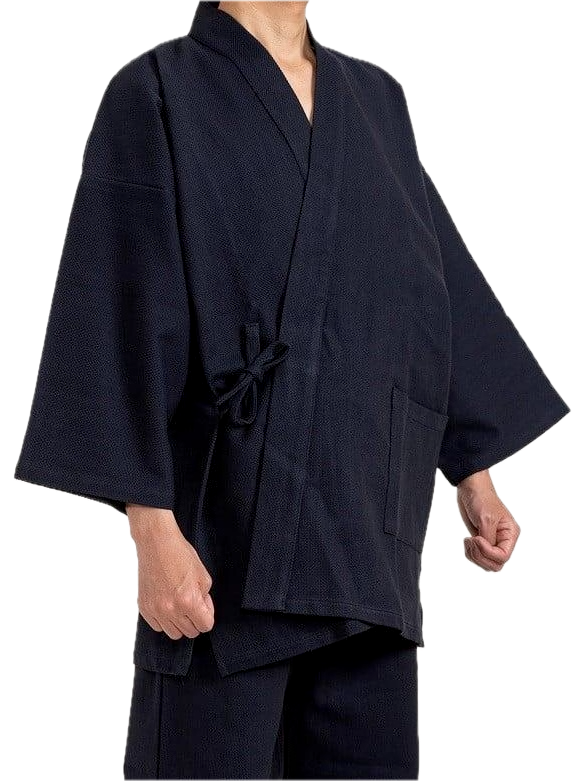
A Ninjutsugi is a martial arts uniform used by contemporary Ninjutsu practitioners.
It generally consists of a jacket and trousers, with an appropriate belt when required.
Depending on the manufacturer, Ninjutsugi designs may resemble other Japanese martial arts uniforms.
Why Choose a Ninjutsugi?
A correctly selected Ninjutsugi can be practical for regular indoor and outdoor martial arts training.
Its main advantages include:
- Freedom of movement during Taijutsu.
- Comfort during repeated practice.
- Appropriate construction for martial arts use.
- Compatibility with many traditional training methods.
- Ease of incorporating a suitable training belt.
How Should a Ninjutsugi Fit?
The jacket should allow the arms to move freely without pulling across the shoulders.
The trousers should provide sufficient room for bending the knees, lowering the body and changing posture.
Avoid uniforms that are excessively tight, particularly around the hips and thighs.
Also avoid unnecessarily long sleeves or trouser legs that may interfere with movement.
For regular Ninjutsu training, a properly fitted, instructor-approved Ninjutsugi is generally a more practical first purchase than an elaborate traditional-style ninja outfit.
4. Shinobi Shōzoku (忍び装束) — Do Beginners Need a Traditional Ninja Outfit?
The term Shinobi Shōzoku is commonly used today to describe traditional-style ninja clothing.
A complete outfit may include:
- Uwagi (上着) — upper garment or jacket.
- Traditional-style trousers.
- Obi (帯) — belt.
- Zukin (頭巾) — hood.
- Tekko (手甲) — hand and forearm coverings.
- Kyahan (脚絆) — lower-leg wraps.
The exact composition depends on the manufacturer and model.
Modern Shinobi Shōzoku clothing is often associated with traditional Ninjutsu practice and Japanese ninja imagery.
However, historical shinobi did not necessarily wear one standardized outfit.
Clothing appropriate to ordinary travel, work or disguise could be more useful than a recognizable uniform.
Is a Complete Shinobi Shōzoku Necessary?
For beginners, the answer is generally no.
A complete traditional-style outfit may become relevant for specific training, cultural study or instructor requirements.
However, it is not essential for developing the foundations of Ninpō Taijutsu.
A practical uniform should always take priority over unnecessary accessories.
Explore Shinobi Shōzoku5. Ninja Tabi vs Jikatabi — Which Footwear Should Beginners Choose?
Footwear is particularly important because it influences how the feet interact with the training surface.
However, there is no universal Ninjutsu footwear requirement.
Some dōjō train barefoot, while others permit or require specific types of Japanese footwear.
Traditional Ninja Tabi (足袋)
Tabi are Japanese split-toe foot coverings distinguished by the separation of the big toe from the remaining toes.
Traditional Tabi are associated with Japanese clothing and specific forms of footwear.
Certain fabric Tabi can be suitable for indoor martial arts practice when permitted by the instructor and compatible with the training surface.
They may provide:
- Lightweight foot coverage.
- A flexible textile construction.
- Close contact with the floor.
- Compatibility with traditional Japanese clothing.
However, fabric Tabi generally provide limited sole protection.
They should not be considered equivalent to outdoor training shoes.
Shop Japanese Ninja TabiJikatabi (地下足袋) — Outdoor Split-Toe Footwear
Jikatabi are Japanese split-toe footwear featuring an external sole, commonly made from rubber.
Unlike traditional fabric Tabi, modern Jikatabi are designed for practical outdoor activities.
Depending on their construction, they may be suitable for outdoor Ninjutsu training.
Potential advantages include:
- Greater sole protection than fabric Tabi.
- Flexibility appropriate to certain movements.
- Traction suited to specific outdoor surfaces.
- Close awareness of ground conditions.
- A practical fastening system.
Different Jikatabi models have different soles and levels of cushioning or protection.
A model suitable for dry grass may not perform equally well on wet stone, mud or steep terrain.
Beginners should select footwear according to actual conditions rather than assuming every Jikatabi is suitable for all environments.
Explore Japanese JikatabiTabi vs Jikatabi — Quick Comparison
| Feature | Traditional Tabi | Jikatabi |
|---|---|---|
| Construction | Primarily textile | Textile upper with external sole |
| Typical Use | Traditional clothing and suitable indoor practice | Outdoor activities and suitable martial arts training |
| Ground Protection | Limited | Depends on sole construction |
| Outdoor Traction | Generally unsuitable | Varies by model and surface |
| Beginner Purchase | Only if required or appropriate | Useful when outdoor training requires it |
Important Footwear Advice
Do not use traditional textile Tabi as a substitute for suitable outdoor protective footwear.
Always check the training surface, weather conditions, traction and instructor requirements.
6. Do Beginners Need Tekko, Kyahan and an Obi?
Traditional Japanese clothing includes accessories that may help secure garments or provide limited environmental coverage.
However, these items are not universally required for beginner Ninjutsu training.
Tekko (手甲) — Hand and Forearm Coverings
Tekko are traditional Japanese coverings worn around the hands, wrists or forearms depending on their design.
They may be incorporated into traditional-style Shinobi Shōzoku or other Japanese garments.
Their role depends on their construction, materials and intended use.
Textile Tekko should not be assumed to provide protection against strikes, blades or heavy impacts.
Kyahan (脚絆) — Traditional Lower-Leg Wraps
Kyahan are Japanese lower-leg wraps or gaiters.
They can help secure loose trouser fabric and provide limited coverage during particular activities.
They are also commonly included in contemporary traditional-style ninja outfits.
For beginners, Kyahan are optional unless specifically requested by the instructor.
Obi (帯) — The Training Belt
An Obi can help secure martial arts clothing and may form part of the uniform requirements of a particular school.
However, the style, color and meaning of the belt depend on the martial arts organization.
Beginners should follow their dōjō's instructions concerning belt selection.
Prioritize a suitable training uniform and required footwear. Tekko, Kyahan and specialized traditional accessories can usually be considered later.
7. Do Beginners Need Ninjutsu Weapons and Training Tools?
Traditional Japanese martial arts include numerous weapons and specialized training implements.
However, beginning Ninjutsu does not mean purchasing a collection of ninja weapons.
A responsible training progression begins with understanding body movement, balance, posture and distance.
Weapon training should only be introduced under appropriate supervision and according to the instructor's curriculum.
Examples of Traditional Training Tools
Depending on the school and level of practice, supervised training may involve:
- Bō (棒) — long wooden staff.
- Hanbō (半棒) — shorter wooden staff.
- Jō (杖) — medium-length staff.
- Bokutō (木刀) — wooden training sword.
- Other specialized practice equipment approved by the instructor.
These examples do not imply that every Ninjutsu school uses the same weapons or follows the same curriculum.
What Should Beginners Avoid?
Beginners should avoid purchasing sharp weapons, throwing implements or potentially dangerous equipment without proper instruction.
Even wooden practice weapons can cause serious injury when used incorrectly.
Appropriate supervision, safe training methods and compliance with local laws are essential.
Learn the fundamentals of Ninpō Taijutsu before investing in specialized weapon equipment. Always purchase training tools according to your instructor's guidance.
8. Indoor vs Outdoor Ninjutsu Equipment
The training environment directly influences equipment requirements.
Indoor Dōjō Training
Indoor Ninjutsu training may focus on Taijutsu, Kamae, Tai Sabaki, Ukemi and partner exercises.
Typical equipment considerations include:
- Comfortable Ninjutsugi or approved training clothes.
- Appropriate belt when required.
- Bare feet or approved indoor footwear.
- Safe training surfaces.
- Instructor-approved practice tools.
Outdoor Ninjutsu Training
Outdoor training introduces additional environmental variables.
These may include grass, soil, gravel, uneven ground, changes in elevation and seasonal weather conditions.
Equipment selection should consider:
- Footwear traction and sole protection.
- Temperature and weather conditions.
- Clothing durability.
- Freedom of movement.
- Environmental hazards.
- Hydration and appropriate personal supplies.
Natural Movement in Togakure Ryū Ninpō
In the practice of Togakure Ryū Ninpō (戸隠流忍法), the relationship between the body and its surroundings is fundamental.
Kamae, Maai, Tai Sabaki and Ukemi are developed through regular training.
Shinobi Aruki (忍び歩き), or controlled stealth walking, also requires observation, balance and appropriate body mechanics.
Specialized footwear may influence the practitioner's contact with the ground.
However, equipment alone cannot produce silent movement or correct martial technique.
These abilities require consistent physical practice.
For information about Togakure Ryū Ninpō training in Kyoto, Japan, visit Ninjutsu Kyoto — Togakure Ryū Ninpō Dōjō .
9. Beginner Ninjutsu Equipment Comparison
The following table helps beginners identify which equipment should be considered first.
| Equipment | Purpose | Beginner Priority |
|---|---|---|
| Comfortable Training Clothes | Natural movement and introductory practice | Essential |
| Ninjutsugi | Regular martial arts training | Recommended when required |
| Obi | Securing the uniform and meeting dōjō requirements | Depends on instructor |
| Ninja Tabi | Traditional footwear and suitable indoor use | Optional or instructor-dependent |
| Jikatabi | Appropriate outdoor training | Recommended when suitable |
| Shinobi Shōzoku | Traditional-style training clothing | Optional |
| Tekko | Hand and forearm covering | Optional |
| Kyahan | Securing lower-leg clothing | Optional |
| Practice Weapons | Supervised technical training | Only when instructed |
Equipment requirements vary between Ninjutsu schools and individual instructors. This table provides general buying guidance, not a universal martial arts uniform standard.
10. Complete Beginner Ninjutsu Equipment Checklist
Use this checklist before purchasing your first Ninjutsu training equipment.
Essential — Before Your First Lesson
- ☐ Comfortable clothing suitable for physical movement.
- ☐ Confirmation of your dōjō's uniform requirements.
- ☐ Appropriate footwear if required.
- ☐ Water and personal training necessities.
- ☐ Understanding of basic training safety rules.
Recommended — For Regular Practice
- ☐ Correctly sized Ninjutsugi.
- ☐ Appropriate Obi if required.
- ☐ Indoor footwear approved by the instructor.
- ☐ Suitable Jikatabi for outdoor training when appropriate.
- ☐ Weather-appropriate clothing.
Optional — As Your Training Develops
- ☐ Traditional-style Shinobi Shōzoku.
- ☐ Tekko hand and forearm coverings.
- ☐ Kyahan lower-leg wraps.
- ☐ Additional training footwear.
- ☐ Specialized equipment required by the curriculum.
Only with Instructor Approval
- ☐ Wooden training weapons.
- ☐ Specialized martial arts practice tools.
- ☐ Equipment intended for advanced exercises.
11. Common Mistakes When Buying Ninja Gear
Mistake 1 — Buying Equipment for Appearance Alone
A visually impressive ninja outfit is not necessarily suitable for demanding martial arts training.
Construction, movement and durability must take priority over appearance.
Mistake 2 — Purchasing the Wrong Footwear
Traditional fabric Tabi and rubber-soled Jikatabi serve different purposes.
Choose footwear according to the actual training surface.
Mistake 3 — Choosing an Incorrect Uniform Size
A uniform that restricts the shoulders, hips or knees can interfere with training.
Check garment measurements and manufacturer sizing information.
Mistake 4 — Buying Too Many Accessories
Beginners sometimes purchase Tekko, Kyahan, hoods and specialized tools before understanding whether they are necessary.
A progressive approach is usually more economical and practical.
Mistake 5 — Purchasing Weapons Too Early
Weapons training requires appropriate supervision and technical foundations.
Avoid buying specialized weapons without instructor approval.
Mistake 6 — Assuming Equipment Creates Skill
Wearing traditional Japanese martial arts clothing does not automatically develop balance, timing or technical ability.
These qualities require practice, repetition and experience.
12. How Your Ninjutsu Equipment Should Evolve with Training
An effective equipment strategy should follow your technical development.
Stage 1 — Beginning Ninjutsu
Focus on comfortable clothing, correct movement and the requirements of your instructor.
Avoid unnecessary purchases.
Stage 2 — Regular Ninpō Taijutsu Practice
As your training becomes more consistent, consider a dedicated Ninjutsugi and appropriate footwear.
Choose equipment based on repeated practical use.
Stage 3 — Outdoor Training
When outdoor practice becomes part of your training, investigate suitable Jikatabi, durable clothing and weather-appropriate equipment.
Learn to evaluate different terrain conditions.
Stage 4 — Specialized Training
Additional accessories and instructor-approved training tools may become relevant as your curriculum develops.
Traditional-style Shinobi Shōzoku, Tekko and Kyahan may also be considered when appropriate.
The Bujindō Philosophy
Ninjutsu equipment should develop alongside the practitioner.
The purpose of traditional martial arts clothing is not merely to represent the image of the ninja.
It should support the practical requirements of training.
Practice, patience and perseverance remain more important than the quantity of equipment owned.
13. Frequently Asked Questions About Beginner Ninjutsu Gear
What equipment do I need for my first Ninjutsu class?
For your first lesson, comfortable training clothes and any equipment specified by your instructor are generally sufficient. A complete ninja outfit is not usually necessary.
Do beginners need a black Ninjutsu uniform?
Not always. Uniform requirements vary between Ninjutsu schools. Beginners should confirm the dress code before purchasing a dedicated Ninjutsugi.
What is the best Ninjutsu uniform for beginners?
A good beginner Ninjutsugi should be comfortable, durable, correctly sized and suitable for the movement requirements of the dōjō.
Should I buy Ninja Tabi or Jikatabi?
Traditional fabric Tabi may be appropriate for certain indoor uses. Jikatabi are designed with external soles and may be more suitable for outdoor practice. Always follow your instructor's guidance.
Are Jikatabi necessary for outdoor Ninjutsu?
Jikatabi can be useful for appropriate outdoor training, but they are not universally required. Their suitability depends on the terrain, sole construction and activity.
Do beginners need Shinobi Shōzoku?
No. A complete traditional-style Shinobi Shōzoku is usually optional. Beginners should prioritize practical training clothing.
What are Tekko and Kyahan?
Tekko are Japanese hand and forearm coverings, while Kyahan are traditional lower-leg wraps. They may form part of traditional-style ninja clothing.
Do I need weapons to start Ninjutsu?
No. Beginners should develop fundamental movement skills before purchasing specialized training weapons. Any practice tools should be approved by the instructor.
Is expensive ninja equipment necessary?
No. Correct fit, comfort, durability and suitability for training are generally more important than price or elaborate appearance.
Can I practice Ninjutsu without special shoes?
Many training environments permit or require barefoot practice. Other dōjō use specific footwear. Follow your instructor's rules and the requirements of the surface.
Where can beginners buy Japanese Ninjutsu equipment?
BujindoShop offers selected Japanese Ninjutsu uniforms, Shinobi Shōzoku, Ninja Tabi, Jikatabi and traditional martial arts accessories.
Compare product materials, measurements and intended uses before purchasing.
14. Shop Essential Ninjutsu Gear at Bujindō
Bujindō (武神堂) is a Kyoto-based Japanese martial arts equipment store informed by practical experience in traditional Ninjutsu and Japanese martial culture.
Our approach emphasizes functional equipment, traditional craftsmanship and the relationship between martial arts knowledge and physical practice.
Whether you are attending your first Ninjutsu lesson or beginning regular Ninpō Taijutsu training, choose equipment according to your actual needs.
Explore Our Beginner Ninjutsu Collections
Ninjutsugi — Training Uniforms
Explore martial arts uniforms suitable for regular practice.
Shop NinjutsugiNinja Tabi — Japanese Split-Toe Footwear
Discover traditional Japanese Tabi in different materials and constructions.
Shop Ninja TabiJikatabi — Outdoor Japanese Footwear
Compare Japanese split-toe footwear for appropriate outdoor activities.
Shop JikatabiShinobi Shōzoku — Traditional-Style Ninja Clothing
Explore complete traditional-style Ninjutsu clothing sets.
Shop Shinobi ShōzokuContinue Learning About Ninjutsu Equipment
Before purchasing additional equipment, explore our educational resources.
About the Bujindō Approach
Bujindō was developed around the study and practice of Japanese martial traditions, including Togakure Ryū Ninpō.
Our educational approach draws upon practical experience in Ninjutsu training in Kyoto, Japan.
Rather than recommending equipment solely on appearance, we emphasize appropriate fit, mobility, materials, training conditions and responsible use.
Conclusion — Start Ninjutsu with the Right Equipment
Beginning Ninjutsu does not require an expensive collection of traditional ninja equipment.
The most important first step is finding appropriate instruction and developing the fundamental movements of the martial art.
A comfortable Ninjutsugi, suitable footwear and basic personal equipment are generally sufficient for regular introductory practice, depending on your dōjō.
Specialized accessories such as Shinobi Shōzoku, Tekko, Kyahan and training weapons can be considered progressively.
Choose equipment because it serves a genuine purpose in your training.
True Ninjutsu begins with practice, not appearance.
Bujindō 武神堂 — Traditional Japanese Martial Arts Equipment, Knowledge and Practice.