
Summer Ninja Outfit vs Ninjutsugi vs Costume: What Is the Difference?
Ninja clothing buying guide
Summer Ninja Outfit vs Ninjutsugi vs Costume: What Is the Difference?
They may all look like black ninja clothing in a product image, but they are not designed for the same job. A lightweight summer ninja outfit, a Ninjutsugi made for martial-arts practice and an entertainment costume differ in construction, freedom of movement, durability, historical positioning and intended use.
This guide explains those differences without treating every black outfit as historically authentic or suitable for training. Use it to identify the right category first, then verify the exact product specifications before placing an order.

Summer Ninja Outfit vs Ninjutsugi vs Costume: At-a-Glance Comparison
| Criterion | Summer ninja outfit | Ninjutsugi | Ninja costume |
|---|---|---|---|
| Primary purpose | Warm-weather wear, selected practice, demonstrations or a shinobi-inspired presentation | Repeated Ninjutsu or martial-arts training | Cosplay, parties, theatre, photography or entertainment |
| Typical design priority | Lower coverage or lighter construction, mobility and visual character | Movement, durability and practical dojo use | Immediate visual effect and accessible price |
| Training suitability | Possible only when construction and dojo rules match the activity | Usually the strongest candidate, subject to instructor approval | Usually unsuitable unless specifically engineered and tested for movement |
| Warm-weather comfort | Potentially high, depending on weave, weight, cut and ventilation | Variable; some uniforms use heavier cloth for durability | Unpredictable; thin synthetic fabric can still trap heat |
| Expected durability | Depends on seams, reinforcements and intended use | Generally selected for repeated practice, but specifications still matter | Often designed for occasional wear rather than grabs, rolls or kneeling |
| Historical claim | May be inspired by modern interpretations of shinobi clothing | A contemporary training uniform, not proof of historical dress | A modern entertainment representation |
| Best for | Buyers seeking a cooler, distinctive ensemble after checking its real specifications | Students who need a dependable uniform approved by their dojo | Buyers who need a recognizable look without martial use |
Important: these are category-level differences, not guarantees. A well-made lightweight outfit may be more robust than a low-quality uniform, and a premium stage costume may be better constructed than a disposable disguise. Read the specifications of the exact item.

What Is a Summer Ninja Outfit?
A summer ninja outfit is a modern warm-weather ensemble that combines a recognizable shinobi-inspired silhouette with less coverage, lighter fabric or a more ventilated construction. Depending on the maker, it may include a sleeveless or short-sleeved top, loose trousers, a belt, arm or leg coverings, a hood, or a mask.
The term describes an intended seasonal use; it is not a standardized historical or technical classification. One seller's summer outfit may be made for demonstrations and light practice, while another may be intended mainly for visual presentation. Before buying, verify exactly what is included and what the maker says the garment is designed to withstand.
Advantages of a summer ninja outfit
- Less fabric around the arms may improve ventilation and shoulder freedom.
- A loose lower garment can support deep stances when it is cut correctly.
- Separate pieces make it possible to adjust coverage for an indoor class, outdoor demonstration or photo session.
- The silhouette is more visually distinctive than a standard training uniform.
Points to check before training in one
- Are the shoulder openings and seams finished for repeated movement?
- Does the crotch allow low movement without pulling?
- Are the belt, gaiters and arm guards secure without hard exposed parts?
- Can the fabric tolerate kneeling, rolling or controlled partner grabs?
- Does your instructor permit this style of clothing in class?
A sleeveless design may feel cooler, but it also exposes the skin to mats, vegetation, sun and contact with a partner. The right choice depends on the activity—not on temperature alone.
What Is a Ninjutsugi?
Ninjutsugi — 忍術着( ninjutsu-gi, “Ninjutsu clothing”) is a contemporary term used for a uniform made or marketed for Ninjutsu practice. It is related to the broader concept of a keikogi — 稽古着(, keikogi, “training clothing”), the general Japanese term for martial-arts practice wear.
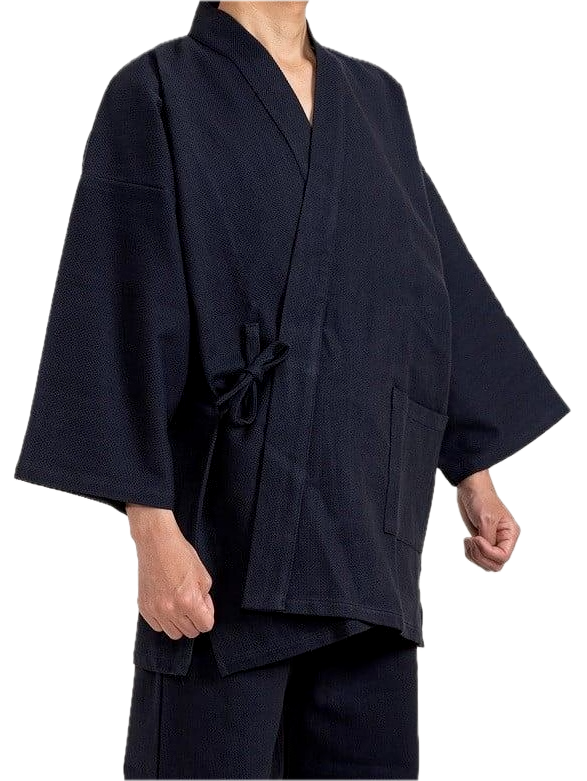
A typical Ninjutsugi uses a wrap-front jacket, a belt and full-length trousers. The fabric may be more substantial than that of a summer outfit because a training uniform has to cope with repeated bending, kneeling, rolling, gripping and washing. Construction varies, however; the word Ninjutsugi does not guarantee a particular cloth weight or reinforcement pattern.
Why regular practitioners usually choose a Ninjutsugi
- Its simple form is compatible with a wide range of training movements.
- Full sleeves and trousers provide more coverage during floor work.
- A plain uniform is less likely to distract from instruction.
- Many dojos already have clear rules concerning color, belt and uniform style.
- Replacement jackets or trousers may be easier to source than specialized outfit components.
If training is your priority, start with the rules of your school and compare the garment measurements, cloth and care instructions. Explore the BujindoShop Ninjutsugi collection only after confirming what your instructor expects.
What Is a Ninja Costume?
A ninja costume is made primarily to communicate the popular image of a ninja. It may be appropriate for cosplay, festivals, parties, theatre, film, photography or a themed event. It is not automatically inferior for those purposes: a costume can be the correct choice when visual effect, ease of use and occasional wear matter more than martial performance.
The problem begins when an entertainment garment is mistaken for protective or training equipment. Thin glossy fabric, decorative ties, exposed fasteners and lightly finished seams may fail during deep stances, falls or partner work. A mask or hood can also restrict peripheral vision, hearing or breathing when the user moves vigorously.
Signs that an item is intended mainly as a costume
- The product description focuses on parties, cosplay, Halloween or stage use.
- No information is provided about seam construction, reinforcements or movement.
- The outfit uses decorative components that could catch during training.
- Sizing is very broad, such as “one size,” with few finished-garment measurements.
- The mask, hood or accessories take priority over the functional jacket and trousers.
For a photo shoot or event, these features may be acceptable. For a dojo, choose clothing explicitly suitable for the movements you will perform and obtain instructor approval.
Which Ninja Clothing Should You Choose?
Choose a summer ninja outfit if…
- you want a shinobi-inspired ensemble designed with warm weather in mind;
- you have verified the precise fabric, included pieces and intended use;
- your dojo or event permits the garment;
- you value visual presentation as well as mobility;
- you understand that “summer” and “Made in Japan” do not, by themselves, prove training performance or historical accuracy.
Choose a Ninjutsugi if…
- you train regularly and need a straightforward uniform;
- durability, coverage and repeated washing matter more than a theatrical silhouette;
- your instructor asks for a black keikogi or Ninjutsugi;
- you perform rolls, kneeling work, partner drills or other repeated movements;
- you prefer a category built around practice rather than presentation.
Choose a ninja costume if…
- your purpose is cosplay, a party, theatre, video or photography;
- you need a recognizable visual effect for occasional wear;
- you do not intend to use it as martial-arts equipment;
- you have checked visibility, ventilation and safe movement for the event;
- you are comfortable with a modern fictional representation.
Fabric and Construction: What Matters in Summer?
The fiber label is only the beginning. Warm-weather comfort depends on fabric weight, yarn, weave, density, surface texture, cut and airflow. Two garments both described as cotton can feel completely different, while a carefully constructed blend may dry faster than a heavier pure-cotton cloth.
| Factor | Cotton | Synthetic fiber | Blend |
|---|---|---|---|
| Moisture | Often absorbs moisture well but may stay wet | Often absorbs less and may dry faster | May balance absorption, drying and stability |
| Skin feel | Often soft, depending on weave and finish | Ranges from technical and smooth to hot or slick | Depends on fiber ratio and construction |
| Shrinkage | Possible, especially with heat | Often more dimensionally stable | Varies; follow the maker's care label |
| Best buying question | How light and open is the actual cloth? | Does it move moisture and remain comfortable? | What is the exact composition and purpose of the blend? |
Construction details worth checking
- Reinforced stress points: knees, crotch, underarms and belt area.
- Seam finish: loose raw edges can fray under repeated washing or friction.
- Range of motion: a gusset or adequate crotch geometry can matter more than overall looseness.
- Closures: hooks, buckles or exposed hard parts may be unsafe during partner work.
- Opacity: very light fabric may become transparent in strong light or when wet.
- Care: a garment that cannot be washed conveniently may be impractical for humid summer training.
How Should a Ninja Training Outfit Fit?
A useful fit is neither restrictive nor excessively baggy. You should be able to raise your arms, rotate your shoulders, sit in a deep stance, lift a knee and move on the ground without the garment pulling sharply or shifting out of place.
- Measure your height, chest, waist, hips and inseam with a flexible tape.
- Compare those numbers with the specific product chart—not a generic international conversion.
- Check whether the chart lists body measurements or finished-garment measurements.
- Allow for the underlayer you expect to wear and any shrinkage stated by the maker.
- If an item is handmade or made to order, request sizing confirmation before production begins.
Do not automatically size up because Japanese labels appear smaller. The cut, ease and finished dimensions matter more than the letter printed on the tag.
Does “Traditional Ninja Outfit” Mean Historically Accurate?
Not necessarily. Shinobi shōzoku — 忍び装束(しのびしょうぞく, shinobi shōzoku, “shinobi clothing”) is associated today with the recognizable dress of the shinobi. Modern commercial sets may draw on this silhouette, but that does not establish the existence of one universal uniform worn by every historical ninja.
Historical clothing changed with period, region, status, task and the need to blend into an environment. The all-black popular image was also shaped by later theatre, illustration, film and modern entertainment. It is therefore safer to describe a current product as shinobi-inspired, traditional-style or made for contemporary Ninjutsu practice unless a specific historical reconstruction is documented.
A Ninjutsugi is even clearer: it is modern practice wear. A costume is a modern representation for entertainment. Neither becomes a historical artifact simply because it is black or includes a hood and mask.
Training Safely in Hot and Humid Weather
Light clothing can improve comfort, but it cannot remove the risks created by heat, humidity, direct sun and high-intensity exercise. Adjust the session to the real conditions.
- Ask the instructor to reduce intensity, duration or protective layers when conditions require it.
- Drink regularly and do not wait until severe thirst develops.
- Schedule breaks in shade or a cool, ventilated space.
- Use sun protection for exposed skin during outdoor practice.
- Change out of wet clothing after the session and allow garments to dry fully.
- Stop if you develop headache, nausea, dizziness, unusual weakness or confusion.
Marked confusion, collapse or rapidly worsening symptoms require urgent medical assistance. Clothing choice supports heat management; it does not replace hydration, rest, supervision or appropriate scheduling.
One-Minute Buying Checklist
Before choosing any summer ninja outfit, Ninjutsugi or costume, answer these questions:
- Purpose: training, demonstration, cultural presentation, cosplay or photography?
- Permission: does the dojo, school or event allow this style?
- Contents: which exact pieces are included?
- Fabric: what is the composition, weight and weave?
- Movement: is it designed for low stances, rolls, kneeling and partner work?
- Safety: are there hard, sharp, loose or vision-restricting parts?
- Size: are the listed numbers body or garment measurements?
- Care: can it be washed and dried often enough for summer use?
- Origin: is the manufacturing country stated precisely?
- Claims: are words such as “authentic” or “traditional” supported by specific evidence?
- Terms: if made to order, have you checked lead time, changes, cancellation and return conditions?
For a wider overview of footwear, leg protection and other essentials, read the Ninjutsu Equipment Guide and the main BujindoShop Buying Guide.
Frequently Asked Questions
What is the main difference between a summer ninja outfit and a Ninjutsugi?
A summer ninja outfit is usually a lightweight, warm-weather ensemble inspired by shinobi clothing. A Ninjutsugi is a modern martial-arts uniform intended primarily for repeated Ninjutsu training. Exact construction varies by maker, so check the fabric, seams and dojo rules before buying.
Can I train in a ninja costume?
Most entertainment costumes are not designed for throws, rolls, grabs or repeated kneeling. Train in one only if your instructor approves it and its fabric, seams, closures and range of motion have been checked for the planned activity.
Is a summer ninja outfit historically accurate?
A modern summer ninja outfit may draw on the silhouette associated with shinobi shōzoku, but appearance alone does not prove that it reproduces one universal historical ninja uniform. Historical claims require specific evidence for the period, region and use.
What should a beginner wear for Ninjutsu training?
Ask the instructor first. Many dojos prefer a simple black keikogi or Ninjutsugi that allows safe movement and has no exposed hard parts. A complete shinobi-style set is not a universal requirement.
Is cotton always the best material for a summer ninja outfit?
No. Cotton can feel comfortable and absorb moisture, but it may remain wet. Some synthetic or blended fabrics dry faster. Fabric weight, weave, ventilation and cut matter as much as the fiber name.
Should a ninja training uniform fit loosely?
It should provide enough room for deep bends, kicks, rolls and shoulder movement without becoming so loose that it twists, catches or creates unsafe grips. Compare body measurements with the maker's size chart.
Is a black outfit too hot for summer?
Dark surfaces generally absorb more solar radiation than light ones, so direct sun matters. Indoors, fabric construction, ventilation, humidity and training intensity may have a greater effect. Take breaks and adapt the session regardless of color.
Are jika-tabi part of an ancient ninja uniform?
Modern jika-tabi with rubber soles are not ancient footwear. Bridgestone's corporate history dates the commercial launch of Asahi Jika-tabi to 1923. They may be useful contemporary footwear, but they should not be presented as proof of medieval ninja equipment.
Can I use the same outfit indoors and outdoors?
Only if the garment and footwear suit both surfaces and the dojo permits them. Outdoor soles should not be used on a clean training floor unless explicitly authorized. Exposed skin and lightweight fabric may also need more protection outdoors.
Does Made in Japan automatically mean suitable for Ninjutsu training?
No. Country of manufacture can be important for provenance and craftsmanship, but suitability depends on the exact design, cloth, seams, fit and intended use. Check the individual product description and ask your instructor.
Choose by purpose, not by appearance alone
For regular practice, begin with a dojo-approved Ninjutsugi. For a lighter shinobi-inspired summer ensemble, compare the exact construction and intended use. For entertainment, select a costume that is comfortable and safe for the event—without treating it as training equipment.
Reference sources
- Iga-ryu Ninja Museum, institutional information about Iga ninja and shinobi clothing.
- Bridgestone corporate history, launch of Asahi Jika-tabi in 1923.
- Japan Ministry of Health, Labour and Welfare, heat illness prevention guidance.